The shift to remote and hybrid work has blown holes in the old idea of “centralized” IT control. When your team sits in one office, it’s easy to enforce standard software builds, security policies, and network access rules. But when your servers, endpoints, and users scatter across time zones and home routers, control becomes more distributed - and sometimes disappears altogether.
That’s where many organizations falter. They instinctively try to “tighten up” by rebuilding a kind of central command via remote monitoring tools, VPN rules, or blanket restrictions. But those measures often frustrate remote engineers, slow down work, and still fail to prevent serious breaches. The smarter route is to modernize how security itself is managed: to protect remote IT teams
without demanding total control.
 This ZandaX article explains how protecting remote IT teams helps tech managers maintain security and trust by applying flexible, decentralized controls.
The Challenge of Protecting Remote IT Teams
Decentralization creates a paradox. On one hand, it gives teams autonomy and agility. On the other, it fragments oversight and introduces new risks - unpatched devices, inconsistent data protection, and random shadow IT practices.
Many managers think decentralization equals chaos, but it doesn’t have to. What’s missing is not control, but coordination. Security in 2026 relies less on where people work and more on how systems, devices, and identity services interact. When you design protection around those layers, geography becomes almost irrelevant.
This shift from centralized control to distributed responsibility actually enables faster responses to local threats, and this reduces bottlenecks. For example,
Turn Key Solutions, an IT company, uses decentralized frameworks to enhance security and boosts resilience by setting risk protocols at the local level.
The real challenge is keeping visibility: knowing what’s happening on remote endpoints, which identities have access, and how data moves across your ecosystem. That’s where modern frameworks like decentralized cybersecurity come in - models built to work where central authority can’t easily reach.
1. Strengthen Endpoint Security … Everywhere
Every remote device is a door into your network. Once, that door sat behind a corporate firewall; now it sits in someone’s kitchen, hotel room, or co‑working space. The key to
protecting remote IT teams is making sure each endpoint is locked down by default.
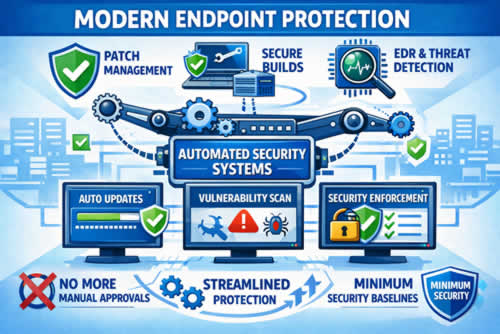
Modern endpoint protection goes beyond antivirus. It means enforcing patch management, ensuring secure builds for laptops and servers, and integrating real‑time endpoint detection and response (EDR). But crucially, automation plays a bigger role than central oversight.
Systems that push updates, track vulnerabilities, and enforce minimum security baselines eliminate the tedious “check‑in” culture where IT staff must manually approve everything.
Using Device‑Level Encryption to Compensate for Lost Perimeter Defenses
When you lose the physical network perimeter, encryption becomes the new boundary. Full‑disk encryption, secure boot processes, and per‑file access restrictions are no longer “nice to have.” They replace the missing corporate firewall by keeping sensitive data unreadable even if devices go missing. It’s a design principle: the assumption that every endpoint will, at some point, live outside your full control.
Picture a remote database administrator who leaves a laptop in a taxi after a long day on a client site. Without encryption, you are relying on the hope that whoever finds it does not know how to extract data from the drive. With enforced device‑level encryption, strong authentication, and the ability to trigger a remote wipe, the incident becomes an inconvenience rather than a breach. The device is lost, but the data remains protected and your regulatory exposure stays close to zero.
2. Adopt “Zero Trust” Principles for Remote Teams
Zero Trust is often mis-sold as a product, when
it’s really a mindset. The premise is simple: no device, user, or connection should be trusted by default - no matter where it originates. Instead of verifying at the “network edge,” you constantly verify at every interaction.
For remote workforce security, this is the most adaptive model available today. A Zero Trust approach authenticates credentials continuously, limits access to the minimum necessary for each role, and detects anomalies (like logging in from two countries at once) automatically. It shifts the balance of power from central control to intelligent verification.
Integrating multi-factor authentication (MFA) across all critical systems should be your minimum baseline. Beyond that, context-based authentication - checking device health, location, and recent behavior - helps stop lateral movement inside your network.
3. Empower Teams With Security Awareness
Technology protects nothing if your people don’t believe in it. The most effective organizations make cybersecurity a team value, not a chore. That means replacing mandatory “tick-box” training with simple, realistic education that fits remote workflows.
Security awareness is not just about phishing drills. It’s about helping teams understand
why controls matter, and giving them ownership of the outcome. When staff see how one careless click or file share can compromise an entire operation, their habits change naturally.
And doing this ensures risks are promptly identified and managed. Clear accountability reduces confusion and speeds decision-making. If you wanted, for example, to
get started with Vendita Technologies, defining these roles early in the transition to remote work is critical to maintaining continuity.

At ZandaX, we strongly believe that empowering remote teams with smart tools, training, and autonomy builds stronger, more resilient security. That’s especially true when engineers or administrators manage privileged access: if they feel trusted and informed rather than micromanaged, they’re more likely to follow good practice by choice, not force.
Realistically, there will always be human mistakes. But awareness ensures that mistakes are spotted quickly and reported openly - not hidden out of fear.
4. Use Policy Automation and Smart Monitoring
Manual enforcement just doesn’t work when your team operates across multiple clouds and continents. Automation is not just about efficiency; it’s about consistency. Security policies defined once can be rolled out globally, instantly, without needing central oversight in every location.
Policy-based configuration tools now do what sysadmins once did by hand - ensuring builds meet compliance standards, that unauthorized apps are blocked, and that suspicious behavior triggers alerts. For example, automated endpoint analytics can flag when a developer’s machine starts connecting to unfamiliar IP ranges, or when credentials are used from outside expected hours.
At the same time, advanced monitoring tools powered by machine learning remove the “all or nothing” dilemma. Instead of locking down systems, they spot unusual activity and let human analysts intervene only when needed. This allows IT teams to maintain security equilibrium while staying productive.
One scenario worth picturing is a remote DevOps engineer who signs in from a new region during a production incident, using an approved VPN but from an unregistered laptop. Smart monitoring automatically restricts access to the most sensitive systems, prompts the engineer to step through an additional verification check, and alerts the security team in the background.
The work can continue, but under tighter controls until the device and identity are fully confirmed. This is how automation preserves both security and velocity without dragging everything back under rigid, centralized control.
5. Protect Data With Decentralized Yet Consistent Governance
If data is your most valuable asset, it must be secured
wherever it travels. Centralized servers are fading away, replaced by distributed cloud apps, local file syncs, and SaaS storage. Maintaining control doesn’t mean bringing data “home”; it means extending governance to wherever that data lives.

Modern data protection frameworks classify data automatically, tag it with sensitivity levels, and apply encryption and access rules accordingly. In cloud services, those rules travel with the data - rather than staying trapped inside a company firewall.
This approach fixes one of the biggest errors in traditional information security: assuming data can be contained. In reality, it moves constantly. The job is not to restrain the flow but to make sure every copy, cache, and transmission stays protected under policy.
That’s why decentralized cybersecurity approaches are becoming more common: they secure identity and data bindings at the edge instead of through central choke points.
Balancing Autonomy With Assurance
A distributed workforce doesn’t need to mean a fragmented defense strategy. The organizations thriving in 2026 are those that trust their teams to make informed decisions while embedding protection into every platform and tool they use.
Managers need to resist the temptation to “re‑centralize” each time a risk appears. Trusted systems, not command hierarchies, keep networks resilient.
Decentralization should be seen as a strength: it removes single points of failure, encourages accountability, and scales decision‑making to where the risk actually lives - at the edge, not the core.
The lesson for anyone protecting remote IT teams is that control is not ownership. Security is a partnership between process, technology, and people. When each works independently but aligns on objectives - protection, visibility, and trust - the organization stays safe by design, wherever its teams work.

If you'd like to learn more about what we provide, why not take a look at how we can help?
Boost your skills with our market-leading online courses at super-low prices.