It goes without saying that most organisations don’t delay their migration to the cloud because they dislike change! They delay it because the systems they rely on every day are older, fragile, and poorly understood, and the risk of disruption feels greater than the risk of standing still.
These “legacy” systems often underpin finance, customer data, scheduling, or reporting. They may not look too impressive, but they work, and they carry years of business logic that no one wants to lose. The challenge is not whether these systems should move to the cloud, but how to do so without introducing new security gaps or operational problems.
This is where AI security tools have started to change the conversation. Not by promising instant transformation, but by making risk visible, measurable, and manageable while systems evolve. This ZandaX article gives you an understanding of the problems – and ways to overcome them – associated with cloud security for legacy systems.
Understanding Risk Exposure with Legacy IT Systems
Risk exposure in legacy systems is rarely obvious. Older systems tend to
accumulate complexity gradually, through patches, integrations, manual fixes, and workarounds applied under time pressure. Each individual change may have made sense at the time, but together they create an environment that’s difficult to reason about.
The result is not necessarily constant failure. In fact, many legacy systems appear stable for years. The real issue is that when something
does go wrong, teams struggle to predict the impact or contain it quickly. Security vulnerabilities, outdated access permissions, and undocumented dependencies all contribute to this hidden exposure.
Consider a business planning to move part of its customer platform to the cloud. The legacy billing system feeding that platform may rely on scheduled jobs, shared credentials, or assumptions about network location that no longer hold once cloud services are introduced. The risk is not theoretical; it sits quietly until the moment of change.
Understanding this kind of exposure requires more than checklists. It requires visibility into how systems actually behave. In this context, security partners like
Schaumburg Managed IT provide the kind of support that helps businesses to map out their technology, identify hidden vulnerabilities, and implement tailored strategies.
The Complexity of Modern Software Systems
Even organisations with relatively small IT teams now operate complex software ecosystems. Cloud services, remote access tools, third-party platforms, and internal applications interact continuously, often across different environments.
Legacy systems rarely sit outside this complexity. They act as data sources, authentication points, or processing engines for newer tools. When these interactions change, intentionally or otherwise, the consequences can be unpredictable. Abd traditional security approaches struggle here because they are designed around static configurations and known threats. They assume that systems behave in fixed ways and that deviations are rare. In modern environments, change is constant, and static assumptions break down quickly.
AI security tools approach complexity from a different angle. Instead of relying solely on predefined rules, they learn patterns of normal behaviour over time. This allows them to detect subtle shifts that might indicate risk, even when no explicit rule has been violated.
For organisations dealing with legacy systems, this behavioural insight is often the missing piece. So companies that want to strengthen their defenses, partnering with trusted providers like
The Zenetrix difference can be transformative. They will use their knowledge of specific challenges to offer comprehensive risk assessments, security audits, and tailored recommendations that few businesses can provide on their own.
The Role of IT Consulting in Reducing Risk
AI tools do not remove the need for human judgement. They provide information, but someone still needs to decide what matters and what does not.
This is where experienced IT consulting becomes valuable. Consultants help translate technical signals into business relevance. They help organisations understand which systems are critical, which risks are acceptable, and which changes require additional safeguards.
In practice, this often starts with
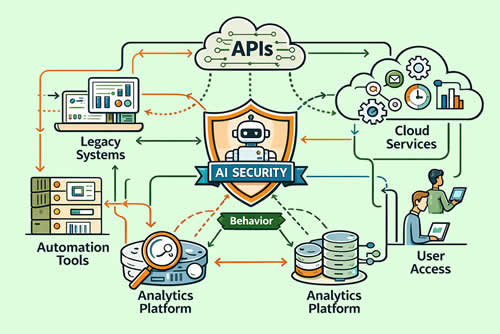
mapping dependencies. A legacy application may seem to be OK … until its data feeds, reporting links, or authentication mechanisms are examined closely. Consultants help uncover these connections before migration begins, reducing unpleasant surprises later. They also help set realistic expectations. Not every legacy system needs to be fully modernised before moving to the cloud. Some can remain largely unchanged, provided their behaviour is well understood and monitored.
AI tools and consulting work best together when the goal is steady risk reduction rather than dramatic transformation.
The New Paradigm: Continuous Monitoring and Maintenance
Legacy systems have traditionally been managed through periodic reviews. Security assessments, upgrades, and audits happen at intervals, often driven by incidents or compliance deadlines.
That model struggles when systems evolve continuously. Cloud platforms update automatically, integrations change, and user behaviour shifts as organisations grow or switch to remote working. Waiting for the next scheduled review can leave long gaps where risk accumulates unnoticed. AI security tools support a more continuous approach. By monitoring systems in real time and learning normal behaviour patterns, they provide ongoing insight rather than snapshots. This allows teams to spot emerging issues early, when they are easier to address.

For example, a legacy system may normally access data in predictable ways. If that pattern changes after part of the system moves to the cloud, the deviation can be flagged quickly. The issue can then be investigated before it escalates into downtime or data exposure.
Continuous monitoring turns migration from a high-risk event into a managed process.
Key Components of IT Resilience for Legacy Systems
Resilience is often discussed in abstract terms, but for legacy systems it comes down to a few practical capabilities. Organisations need to understand what their systems are doing, limit how far problems can spread, and recover quickly when something does go wrong.
AI security tools contribute by providing behavioural visibility that documentation alone cannot offer. They help teams see how systems interact in practice, not just in theory. This visibility makes it easier to isolate issues and prevent them from spilling across to other environments. And equally important is recovery. When teams understand normal behaviour, they can restore systems with greater confidence after an incident. They are not guessing what “healthy” looks like; they have data to guide them.
Resilience doesn’t mean avoiding all incidents. It means reducing their impact and shortening the time to recovery.
Utilizing Managed Services to Boost Resilience
Continuous monitoring and analysis require attention. For many organisations, building and staffing this capability internally is neither practical nor desirable.
Managed services provide an alternative. By combining AI tools with experienced analysts, they offer ongoing oversight without the overhead of a full in-house team. This is particularly valuable during cloud migration, when environments are hybrid and risk is spread across old and new systems. A managed service can monitor legacy applications alongside cloud services, identifying patterns that span both. This unified view is difficult to achieve when responsibility is fragmented across teams or tools.

The benefit isn’t just technical coverage, but peace of mind. Decision-makers know that risk is being actively managed while the organisation focuses on its primary objectives.
Building a Culture of Resilience
Technology alone cannot deliver resilience: the way people respond to risk matters just as much.
Organisations that achieve legacy migration successfully tend to treat security as part of normal operations, not as an occasional project. They encourage teams to report anomalies early and view them as opportunities to learn … not failures to hide.
AI security tools support this mindset by reducing uncertainty. When teams are confident that unusual behaviour will be flagged promptly, they are more comfortable making incremental changes. Progress feels safer because surprises are less severe. Over time, this leads to better decision-making. Leaders stop asking whether change is “safe enough” and start asking how risk will be observed and managed as systems evolve.
Conclusion: Welcoming the Future
Moving legacy systems to the cloud is rarely straightforward, and the need to
preserve existing technology can be frustrating, but it doesn’t need to be reckless. The greatest risks often come from what organisations cannot see, rather than from the technology itself. AI security tools help to close that visibility gap. By focusing on behaviour, continuous monitoring, and early detection, they allow organisations to modernise gradually while keeping risk under control.
Supported by thoughtful consulting and, where appropriate, managed services, businesses can move forward without discarding the systems they still depend on. The future of cloud migration is not about abandoning the past, but about understanding it well enough to evolve safely.

If you'd like to learn more about what we provide, why not take a look at how we can help?
Boost your skills with our market-leading online courses at super-low prices.