We're living through a proxy boom. With online safety now a priority in many countries, proxy usage is booming as businesses look for work-arounds to new data rules. Meanwhile, according to Axios, Cloudflare’s CEO Matthew Prince says an industry-wide anti-crawling shield is coming and that “every publisher you have ever heard of is on board.”
High demand and tougher defenses make
picking a budget proxy more than a cost choice – it’s survival. This ZandaX guide compares nine affordable providers, scoring each on a 100-point, price-to-performance rubric so you can choose the one that clears blocks without draining your budget.

How We Ranked the Providers
A
rubric is basically a scorecard for quality, often used by educators when assessing work. Well, we built our own: a 100-point rubric that mirrors real-world decisions, with value for money (obviously) carrying the most weight.
First, we measured
entry price and
true scaling costs. Cheap proxies that collapse under load still score low, so price and value supply 25 points.
Next is
network depth. A broad, diverse IP pool lowers block rates and widens geo-targeting, adding 20 points.
Performance – that’s speed, uptime, and success rate—contributes another 20. We verified claims through public benchmarks, vendor dashboards, and our own tests.
Privacy counts, especially as rules tighten. Providers with no-log policies and ethically sourced IPs earn 15 points.
Features such as
SOCKS5 support,
sticky sessions, and
flexible authentication add 10.
The final 10 points cover
customer support and
reputation because a deal means very little if help disappears when your scraper fails.
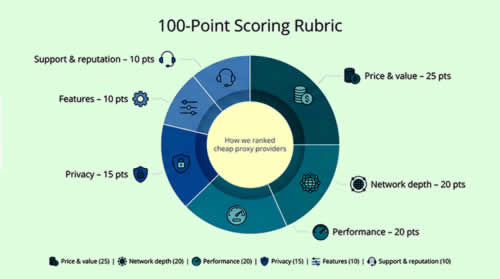
Totals reveal clear leaders and clear laggards. We’ll highlight those scores in each mini-review so you know where your budget works hardest.
Cheap Proxy Providers at a Glance
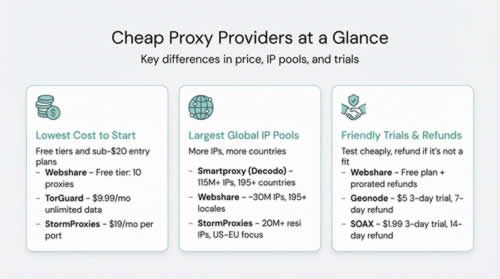
Before we look at each provider, it helps to see the field in one sweep.
Scan the grid below, note entry price, proxy types, and trial policies, then read on for the story behind each one.
Treat this table as your quick reference.
| Core proxy type | Cheapest plan | Pool size / locations |
| TorGuard |
| Datacenter, multiple stealth protocols | $9.99 / month unlimited data | 300+ servers in 22+ countries |
| Webshare |
| Dedicated & shared datacenter (some resi) | Free tier (10 IPs) or $2.99 / 100 IPs | ~30 M IPs, 195+ locales |
| IPRoyal |
| Residential, Mobile, Datacenter, ISP | Resi $7 / GB, DC $1.39 / IP | 2 M+ resi, 60+ DC sites |
| Rayobyte |
| Datacenter IPv4/IPv6, ISP, Resi | IPv4 from $2 / IP (bulk $0.17) | 300 K+ DC IPs, 16+ countries |
| Smartproxy |
| Rotating resi, DC, Mobile | $50 / 4 GB (~$12.5 / GB) | 115 M+ IPs, 195+ countries |
| StormProxies |
| Rotating resi, Dedicated DC | $19 / month per port | 20 M+ resi, US-EU focus |
| Geonode |
| Rotating resi (bandwidth rollover) | $50 / 50 GB ($1 / GB) | 7 M+ IPs, 130+ countries |
| SOAX |
| Rotating resi, Mobile, DC | $44 / 5 GB ($8.8 / GB) | 8 M resi, 120+ countries |
| ProxyEmpire |
| Rotating resi, Static DC | $49 / 8 GB | 5 M+ resi, 100+ countries |
Next, we’ll zoom in on each provider so you can match their strengths to your specific workload.
A Deeper Dive on the Options
1: Torguard: Premium Anonymity on a Budget
Packed with 10 Gbps servers in over 22 countries, zero-log enforcement, and SOCKS5 plus V2Ray stealth modes – features detailed on its
premium anonymous proxy page – the
TorGuard bundle acts like a multi-tool for low-cost data gathering.
For $10 a month you tap an unlimited pool of datacenter IPs across 22 countries. The ten-gig backbone keeps speeds steady, and you can run 15 simultaneous connections without extra fees.
Protocol flexibility is the standout feature. You can switch from HTTP to SOCKS5, Shadowsocks, or V2Ray if a target starts deep-packet scans. That flexibility, paired with a strict no-log policy from the company’s VPN division, explains its strong privacy and performance scores.
Choose TorGuard when you scrape large volumes on sites that accept datacenter ranges or when you want a faster, safer step up from a public VPN.
2: Webshare: Free Taste, Penny-Per-Proxy Scaling
Webshare lets you test without a credit card. Sign up and you get 10 datacenter proxies at no cost. Move to the first paid tier and 100 proxies cost $2.99, with unlimited bandwidth—your thread count becomes the only ceiling.
Scale is the real value. A 30-million-address pool spreads across nearly every country, so fresh IPs are always one click away. Swap dead addresses through a clean dashboard or API and keep requests moving.
The trade-off is type mix. Most IPs sit in datacenters, so strict targets may fight back. For SEO checks, QA testing, or any project with built-in retry logic, Webshare provides unmatched value per dollar among the providers we tested.
3: Iproyal: One-Stop Shop For Every Proxy Type
If managing multiple vendors drains your time,
IPRoyal puts every proxy in one dashboard.
Need unlimited datacenter IPs? Dedicated addresses start around $1.39 each. If a target blocks servers outright, switch to rotating residential or mobile endpoints and pay only for the data you use.
Sourcing is ethical by design. Residential nodes come from opt-in users through the company’s Pawns program, not malware, so reputations stay clean and bans fall on social platforms.
Watch the refund window: you have 24 hours to request your money back. Run a quick proof of concept, then scale with confidence.

If you'd like to learn more about what we provide, why not take a look at how we can help?
Boost your skills with our market-leading online courses at super-low prices.
4: Rayobyte: Bulk Dedicated IPs for Pennies
Some projects burn through IP addresses fast, and
Rayobyte meets that hunger.
Buy a small batch and you pay market-standard rates. Buy hundreds and the per-IP price drops to $0.17, with each address dedicated to you alone, so success stays high even under heavy threading.
Rayobyte owns many of its subnets and lets you choose geography or subnet diversity. Need contiguous blocks for analytics? Done. Prefer mixed ASNs to avoid pattern detection? Also ready.
Support stands out for the price. You get 24-hour ticket coverage and quick replacements if an IP misbehaves.
Remember the trade-off: datacenter IPs, no matter how clean, can trigger strict bot walls. Use Rayobyte for volume scraping, SEO monitoring, or any task where speed and cost outweigh stealth.
5: Decodo: Massive Pool, Minimal Headaches
Smartproxy rebranded as
Decodo last year, yet the promise remains: let you tap a huge proxy network without mastering complex tools.
A single dashboard flips between 115 million residential, mobile, and datacenter IPs across 195 countries. Pick a country, choose rotating or sticky mode, copy the endpoint, and you are live in seconds.
Success rates stay high because stale addresses are purged each day. Unlimited concurrent sessions keep crawl speed in your hands instead of a license limit.
Pricing starts above the "bargain" tiers, but the minutes you save on setup and troubleshooting can repay the premium many times over.
6: Stormproxies: Unlimited Bandwidth, Zero Frills
StormProxies pares the proxy experience to essentials and passes the savings to you.
Instead of billing per gigabyte, it charges by port. Pay $19 a month, whitelist your IP, and push unlimited traffic through a residential back-connect gateway that can rotate on every request or at 3- or 15-minute intervals.
The network is smaller than the giants at about 20 million household addresses focused on North America and Europe, yet reliability stays high for tasks such as Google rank tracking or price monitoring where sheer volume matters more than pinpoint geotargeting.
Setup takes minutes: choose a “USA only,” “EU only,” or “world mix” endpoint and plug it into your crawler. No complex dashboard, no SOCKS5, just steady throughput at a price most teams can approve without debate.

7: Geonode: Roll-Over Bandwidth on a Budget
Geonode sticks with pay-per-gig pricing but fixes the biggest pain point: wasted data.
Unused bandwidth rolls into the next cycle, so you always get full value. The starter plan supplies 50 GB for $50, an effective $1 per gigabyte.
Its residential pool holds 7 million IPs across more than 130 countries. That is smaller than the largest networks yet ample for most scraping jobs, especially because you can run unlimited threads at no extra cost.
Setup is quick: choose rotating or 60-minute sticky mode, copy the endpoint, and track usage through a developer-friendly API. Crypto payments and a 7-day refund period add
privacy and flexibility.
If you need lots of data without surprise overage fees, Geonode keeps your budget intact while carrying unused traffic forward.
8: SOAX: Fresh Ips and Ethical Credentials
SOAX built its name on quality over quantity, then cut prices in half while keeping standards high.
The network offers 8 million residential and mobile addresses that refresh constantly, so you meet fewer dead or overused IPs. City-level targeting lets you appear in downtown Tokyo one minute and rural Texas the next, a feature ad-verification teams value.
Ethics stay front and center. Google’s takedown of the malware-powered IPIDEA network showed the risk of shady sourcing, yet SOAX remained untouched thanks to its opt-in peer model and strict pool hygiene.
Plans start at $44 for 5 GB, and a $1.99 three-day trial lets you test before you commit. If your crawler needs residential credibility without a luxury price, SOAX delivers a safe middle option.
9: Proxyempire: Low-Risk Trial, Straightforward Scaling
ProxyEmpire may be newer, yet its service feels seasoned.
A $1.97 fee unlocks a 7-day trial with 2 GB of residential traffic. That small paywall deters abusers, so the 5 million-address pool stays cleaner than many open networks.
Paid plans remain affordable: 6–8 dollars per gigabyte for residential bandwidth, while static datacenter proxies start near $1 each. Country targeting works today, and city options are rolling out for major metros.
Support is personal. Live chat connects you to staff who solve scraper timeouts or credential errors without delay. A 7-day refund policy guards your budget if a target resists their IPs.
ProxyEmpire will not top the “largest pool” lists, yet when you need a simple, low-risk path into residential proxies, it provides flexible options at a fair price.
Choosing the Right Proxy for Your Needs
Start with the job, not the price!
If raw speed and unlimited threads top your list, datacenter specialists like TorGuard, Rayobyte, or Webshare lead the pack. Their servers sit on gigabit backbones, so you scrape faster and pay a flat fee instead of watching a bandwidth meter.

Need stealth to bypass tough bot walls? Look to residential networks. Smartproxy and SOAX offer large, frequently refreshed home-IP pools that resemble everyday users. They charge more per gigabyte—often $8 to $13—but the higher success rate can cut total crawl time.
Match the payment model to workload. Continuous crawls benefit from unlimited bandwidth, making StormProxies’ port pricing or TorGuard’s flat plan sensible picks. Episodic research projects work well with pay-as-you-go options from Geonode or IPRoyal, where unused data never expires.
Check critical features too. If your toolchain requires SOCKS5, skip Webshare’s shared tier and StormProxies. Need city-level targeting? Choose SOAX or Smartproxy. Prefer crypto payments and a privacy-first stance? Geonode or Rayobyte meet that need.
Line up these requirements, then choose the provider whose strengths match your project brief. The cheapest option isn’t necessarily the lowest price: it’s the one that gets the job done on the first pass.